
More details
Collapse details
Date Published:
Filesize:
- June 7, 2012
Although considerable information is available on residency patterns and spatial use of odontocetes in the eastern half of the Hawai‘i Range Complex (HRC), much less is known about odontocetes in the western half of the HRC. In the second year of a three-year effort in the western main Hawaiian Islands we undertook surveys off Kaua‘i and Ni‘ihau in July/August 2011, to examine spatial use and residency patterns using satellite tags, to provide visual verification of acoustically-detected odontocetes on the Pacific Missile Range Facility (PMRF), and to obtain individual identification photographs and biopsy samples for assessment of population identity and structure.
- 3,048.07 KB
More details
Collapse details
Date Published:
Filesize:
- November 8, 2013
Here we combine results of field efforts funded through the U.S. Navy’s Living Marine Resources Program (through a three-year grant from the Naval Postgraduate School) as well as additional field time in the study area in 2011 and 2012 funded through the Pacific Islands Fisheries Science Center and Commander, Pacific Fleet. We also utilize results from research efforts in the eastern main Hawaiian Islands, off Lāna‘i, Maui, and Hawai‘i Island, to help interpret results from photo-identification and satellite tagging.
- 2,159.00 KB
More details
Collapse details
Date Published:
Filesize:
- May 12, 2025
The National Oceanic and Atmospheric Administration (NOAA) Alaska Fisheries Science Center has maintained passive acoustic recorder moorings in areas of interest to the US Navy in the Gulf of Alaska (GOA). Archival data from three of these sites were analyzed for the timing and occurrence of key cetacean species. In addition, three subsurface passive acoustic moorings were deployed for a year (fall 2023 to fall 2024) in areas of mutual interest to NOAA and the Navy. Two of these new moorings, located along the western GOA slope, were redeployed in 2024.
- 2,832.58 KB
More details
Collapse details
Date Published:
Filesize:
- January 1, 2024
Three subsurface passive acoustic moorings were deployed in the western Gulf of Alaska on the EcoFOCI fall mooring cruise onboard the F/V Aquila 15 Aug – 14 Sep 2023; recovery is planned for September 2024, funding permitting. These mooring will allow investigation into the seasonal occurrence of many species of vocalizing marine mammals including North Pacific right (NPRW), blue, fin, humpback, minke, gray, sperm, killer, and beaked whales, Dall’s and harbor porpoise, general pinniped sounds, and anthropogenic noise sources such as vessels and seismic airguns. This is important data that the Navy needs to prepare environmental planning documentation, including those for the National Environmental Policy Act (NEPA), Marine Mammal Protection Act (MMPA), and ESA documents and consultations. It is also needed to inform the National Marine Fisheries Service Alaska Regional Office’s NPRW critical habitat expansion decision. In addition to the field work, processing of existing passive acoustic recordings from three moorings in the WGOA is ongoing, with one site (Barnabus Trough) completed for the high-frequency band. Killer whale vocalizations were detected on 214 of the 358 days with recordings.
- 1,129.99 KB
Longitudinal comparisons of digital photography of marine mammals from aircraft and shore.
Southern California Marine Mammal Workshop 2014 .
More details
Collapse details
Date Published:
Filesize:
- January 31, 2014
Rapid progress and affordability of photographic technology with increasing improvements in image resolution have facilitated advancements in efficiency and alternative approaches in data collection for marine mamma ls. We report these recent improvements by comparing marine mammal photographs taken during 2008-2013 aerial surveys of 16 marine mammal species in the Southern California Bight, shore-based studies of bottlenose dolphins (Tursiops truncatus) in Galveston Bay, Texas (2011 - 2013), and gray whales (Eschrichtius robustus) off Sakhalin Island, Russia (2004 -2010).
- 1,436.95 KB
Line-transect Abundance Estimates of Cetaceans in U.S. Waters around the Hawaiian Islands in 2002, 2010, and 2017.
NOAA technical memorandum NMFS PIFSC. 2021.
115. https://doi.org/10.25923/daz4-kw84
More details
Collapse details
Date Published:
Publication:Ocean:Region:Species:
- January 1, 2021
The Hawaiian Islands Cetacean and Ecosystem Assessment Survey (HICEAS) is a recurring ship-based, line-transect survey designed to estimate cetacean abundance in the entirety of the Hawaiian EEZ.
- Blue whale
- Bryde's whale
- Humpback whale
- Minke whale
- Sei whale
- Blainville's beaked whale
- Bottlenose dolphin
- Goose-beaked whale
- False killer whale
- Fraser's dolphin
- Killer whale
- Longman’s beaked whale
- Melon-headed whale
- Pygmy killer whale
- Risso's dolphin
- Rough-toothed dolphin
- Short-finned pilot whale
- Sperm whale
- Spinner dolphin
- Spotted dolphin
- Striped dolphin
More details
Collapse details
Date Published:
Filesize:
- December 18, 2023
This survey implemented visual line transect and passive acoustic methods to assess the presence and distribution and to estimate density and abundance of cetaceans in Behm Canal and central Clarence Strait.
- 1,093.33 KB
More details
Collapse details
Date Published:
Filesize:
- June 1, 2014
Passive acoustic monitoring was conducted to detect the presence of marine mammal and anthropogenic sounds in the Navy’s Northwest Training Range Complex (NWTRC) from September 14, 2012 until June 30, 2013. High-frequency Acoustic Recording Packages (HARPs) recorded sounds between 10 Hz and 100 kHz at the shelf slope near Quinault Canyon. Data analysis methods consisted of detection of sounds by analyst scans of long-term spectral averages (LTSAs) and spectrograms, and by automated computer algorithms when possible. The data were divided into three frequency bands for analysis of marine mammal vocalizations and anthropogenic sounds.
- 16,828.02 KB
More details
Collapse details
Date Published:
Filesize:
- November 1, 2014
Passive acoustic monitoring was conducted in the Gulf of Alaska Temporary Maritime Activities Area (GATMAA) from June 2013 to May 2014 to detect marine mammal and anthropogenic sounds. High-frequency Acoustic Recording Packages (HARPs) recorded sounds between 10 Hz and 100 kHz at five locations: a shelf site offshore Kenai Peninsula (200 m depth, site CA), a continental slope site in deep water (850 m depth, site CB), a slope site offshore Kodiak Island (230 m depth, site KO), a deep offshore site at Pratt Seamount (1000 m depth, site PT), and a deep offshore site at Quinn Seamount (930 m depth, site QN).
- 15,262.96 KB
Passive Acoustic Monitoring for Marine Mammals in the SOCAL Naval Training Area Dec 2012 – Jan 2014.
More details
Collapse details
Date Published:
Filesize:
- January 1, 2015
Passive acoustic monitoring was conducted in the Navy’s Southern California Range Complex from December 2012 to January 2014 to detect marine mammal and anthropogenic sounds. High-frequency Acoustic Recording Packages (HARPs) recorded sounds between 10 Hz and 100 kHz at three locations: near Santa Barbara Island (880 m), west of San Clemente Island (1000 m), and southwest of San Clemente Island (1300 m). Six baleen whale species were recorded: blue whales, Bryde’s whales, fin whales, gray whales, humpback whales, and minke whales.
- 21,128.75 KB
More details
Collapse details
Date Published:
Filesize:
- June 17, 2012
This document contains amplifying technical data and information for the United States Department of the Navy’s Southern California Range Complex Comprehensive Monitoring Report.
- 51,916.96 KB
Comparison of echolocation clicks produced by four killer whale communities in the northeastern Pacific Ocean.
21st Biennial Conference on the Biology of Marine Mammals .
More details
Collapse details
Date Published:
Filesize:
- December 13, 2015
Visually validated towed hydrophone array recordings made in the presence of four killer whale communities (northern and southern residents, offshores, and west coast transients) were collected during the Pacific Orca Distribution Surveys (PODS) conducted by the Northwest Fisheries Science Center in the winters of 2006-2009, 2012, 2013, and 2015. Killer whale communities are known to exhibit differences in their prey preferences, genetic structure, and acoustic call repertoire, but little is known about differences in echolocation clicks. Over 20,000 echolocation clicks were measured from 49 independent killer whale acoustic encounters that were recorded during these cruises to compare signal parameters between communities. Echolocation click parameters were measured automatically using tools available in PAMGuard software. Results of pairwise comparisons indicated that duration, center frequency, peak frequency, sweep rate, number of zero crossings, and inter-click interval were significantly different (Kolmogorov-Smirnov test, p
- 91.96 KB
More details
Collapse details
Date Published:
Filesize:
- February 25, 2019
Passive acoustic monitoring has been conducted along the U.S. west coast, from Central California to Cape Flattery, to monitor movements of endangered Southern resident killer whales (SRKW). Since 2008, four to seventeen Ecological Acoustic Recorders (EARs) have been deployed, depending on the year and available funding. The rate of successful data acquisition has varied each year due to fishery interactions and equipment failures. EARs were programmed to record on a 5–10% duty cycle depending on the year of deployment, resulting in 30–90 seconds of continuous recording every 300–600 seconds with a sampling rate of 25 kHz.
- 1,398.03 KB
Passive acoustic monitoring reveals spatiotemporal segregation of two fish-eating killer whale Orcinus orca populations in proposed critical habitat.
Endangered Species Research. 2021.
44:253-261. https://doi.org/10.3354/esr01099
More details
Collapse details
Date Published:
Publication:Ocean:Region:Species:Methods:
- January 1, 2021
We used passive acoustic monitoring at 15 sites along the coast of Washington State, USA, to assess habitat use patterns of 2 sympatric populations of fish-eating killer whales Orcinus orca: northern residents (NRKW) and southern residents (SRKW).
A comparison of EAR and SoundTrap performance for acoustic monitoring of resident killer whales.
Journal of the Acoustical Society of America. 2021.
150:A283
More details
Collapse details
Date Published:
Publication:Ocean:Region:Species:Methods:
- October 1, 2021
In this study, we co-located Ecological Acoustic Recorders (EARs) and SoundTraps at five locations along the Washington coast, analyzed each data set separately, and compared the results. Preliminary analysis of these data resulted in a 1.6 to 3.4 times increase in the number of days with RKW detections in the SoundTrap data compared to the EAR data depending on location. We will present the results of this comparison, investigate potential causes of the differences between recorder type, and highlight the implications of these differences to previous knowledge of RKW movements along the Washington coast.
More details
Collapse details
Date Published:
Filesize:
- August 29, 2012
Results from the second year of a three-year project investigating the distribution, demographics, and behavior of cetaceans in the US Navy’s Southern California operational area are summarized. Eighteen small vessel surveys for cetaceans, which included species verification tests in conjunction with M3R (Marine Mammal Monitoring on Navy Undersea Ranges) acoustic monitoring at the Southern California Anti-submarine Warfare Range (SOAR), as well as photo-identification, satellite tagging, and biopsy sampling of species of interest, were conducted in July 2011 and January and March 2012. 112 groups of 14 cetacean species were encountered. Twenty-one satellite tags, some depth reporting, were deployed on four species, with an emphasis on Cuvier’s beaked and fin whales. Among other findings, preliminary results of photo-identification studies combined with results from satellite tag data suggest that both Cuvier’s beaked whales and fin whales may have population sub-units with higher than expected residency to the Southern California Bight. Beaked whales particularly show this higher than expected residency to SOAR.
- 3,587.99 KB
More details
Collapse details
Date Published:
Filesize:
- June 1, 2017
Remotely deployed telemetry tags were used to assess the movements and occurrence of the whales in the winter, and passive acoustic recorders deployed in areas thought to be frequently used by the whales, were used to assess their seasonal occurrence in these areas. These data will be used to provide information to better understand their seasonal occ
- 2,040.50 KB
More details
Collapse details
Date Published:
Filesize:
- August 1, 2018
We integrated opportunistic visual sightings, and the output from an updated state-space movement model fit to the locations from several satellite-tagged Southern Resident killer whales to fill in the detection gaps in the acoustic detections of this population in the coastal waters of the U.S. over a 4-year period when satellite tags were not deployed
- 2,610.25 KB
More details
Collapse details
Date Published:
Filesize:
- January 31, 2022
Autonomous passive acoustic recorders have been used for the past 15 years to monitor the coastal occurrence of Southern Resident killer whales (SRKW), other marine mammals, and anthropogenic noise in and adjacent to the Navy’s NWRTC in Washington State. The five autonomous acoustic recorders in and adjacent to the Navy’s NWTRC were successfully recovered in early September 2021 and new moorings were redeployed at each site.
- 355.18 KB
More details
Collapse details
Date Published:
Filesize:
- June 29, 2015
In this analysis, we integrate limited acoustic detections over a 7-year period with two other data sources: opportunistic visual sightings, and output from a state-space movement model fit to the locations from a single satellite-tagged individual. We illustrate a case study with an application to endangered Southern Resident killer whales, where the focus is understanding the coastal habitat use of this population in winter and spring months. Predictions from our state-space movement model suggest in winter of 2014, SRKWs spent the highest density of time located off the Columbia River and near Westport. Other areas with concentrated effort included off the Olympic Peninsula in Washington State, and near the Mad and Eel rivers in Northern California.
- 2,722.69 KB
More details
Collapse details
Date Published:
Filesize:
- January 1, 2012
In order to support the U.S. Navy in meeting regulatory requirements for monitoring established under the Final Rules and to provide a mechanism to assist with coordination of program objectives under the ICMP, this survey was conducted to confirm the Marine Mammal Monitoring on Navy Ranges (M3R) acoustic detections and marine mammal satellite tagging was prior to a training event, the Submarine Commander’s Course exercise, which would be conducted in the same area during February 2012.This report presents the methods and preliminary results of a vessel-based visual and acoustic survey effort that was conducted in conjunction with a tagging and species-validation project
- 2,313.85 KB
More details
Collapse details
Date Published:
Filesize:
- August 31, 2012
The overall objective of the ICMP is to assimilate relevant data collected across U.S. Navy range complexes in order to answer questions pertaining to the impact of MFAS and explosives on marine mammals and sea turtles.
- 11,672.29 KB
More details
Collapse details
Date Published:
Filesize:
- November 1, 2012
The first phase to integrate the historical sum of these U.S. Navy-sponsored visual survey efforts for marine species monitoring in the HRC was prepared by Uyeyama (2011). This report represents the second phase of that effort and presents an overview of monitoring survey effort to date in the HRC. Available data from visual surveys performed by both contractor-led efforts and U.S. Navy in-house surveys was compiled and processed in order to: 1. Create a geographic information system (GIS)-based summation of all survey tracks that can be easily visualized. 2. Construct a geo-referenced database of sightings that can be queried by species, observer platform, Beaufort Sea State (BSS), season, or other sighting/survey variables. 3. Conduct an enhanced analysis of sighting success with respect to survey platform, field protocol, and environmental conditions. 4. Inform and adjust data collection procedures on future surveys as needed to reflect lessons learned from sighting data compilation efforts presented here. 5. Provide information to enhance informed management of marine protected species in the HRC and support the adaptive management process that is part of the ICM
- 19,704.58 KB
- Hawaiian Monk Seal
- Green turtle
- Bryde's whale
- Humpback whale
- Minke whale
- Sei whale
- Blainville's beaked whale
- Bottlenose dolphin
- Goose-beaked whale
- Fraser's dolphin
- Killer whale
- Longman’s beaked whale
- Melon-headed whale
- Pantropical spotted dolphin
- Pygmy killer whale
- Risso's dolphin
- Rough-toothed dolphin
- Short-finned pilot whale
- Spinner dolphin
- Striped dolphin
More details
Collapse details
Date Published:
Filesize:
- September 19, 2024
This report presents a geographic information system (GIS)-based overview of the sighting records obtained during marine species monitoring effort (a total of 12 U.S. Pacific Fleet-funded surveys) to date in the MIRC. Also included are incidental marine mammal and sea turtle sightings made since 1965 on non-dedicated surveys in the region.
- 14,571.64 KB
More details
Collapse details
Date Published:
Filesize:
- July 1, 2025
Beaked whales (Family Ziphiidae; Order Cetacea) are the least well-described group of marine mammals because they conduct very long deep dives, spend little time on the surface where they display cryptic behavior, and are difficult to identify due to the similarity between species. Beaked whales are also known to be susceptible to high-energy sound sources in the ocean (e.g. seismic research, sonars used by military activities).
- 1,136.54 KB
More details
Collapse details
Date Published:
Filesize:
- February 1, 2018
Marine mammal surveys, initiated as part of the CalCOFI cruises in 2004, were continued during 2016-2017. Visual monitoring incorporated standard line-transect survey protocol which includes two experienced observers scanning for marine mammals during transits between CalCOFI stations.
- 1,472.91 KB
More details
Collapse details
Date Published:
Filesize:
- January 1, 2012
Passive acoustic monitoring was conducted in the Navy’s Southern California Range Complex during May 2011 – March 2012 to detect the presence of marine mammal and anthropogenic sounds. Highfrequency Acoustic Recording Packages (HARPs) recorded sounds between 10 Hz and 100 kHz with nearly continuous temporal coverage at a site near Santa Barbara Island (site M) and at a site west of San Clemente Island (site H). Data analysis consisted of detection of sounds of interest by analyst scans of long-term spectral averages and spectrograms, and by automated computer algorithm detection when possible. Representative sounds are presented in this report, as well as details of the computer algorithms used to detect them.
- 37,599.29 KB
More details
Collapse details
Date Published:
Filesize:
- September 1, 2010
This report summarizes the underwater sounds detected during a series of deployments of a High Frequency Acoustic Recording Package (HARP) in the southern California (SOCAL) offshore region. The HARP records broadband (10 Hz – 100 kHz) acoustic data, including both marine animal and anthropogenic sound. This report summarizes initial analysis to detect the presence of marine mammals by species as well as the occurrence of naval sonar and other anthropogenic sound events.
- 4,006.74 KB
More details
Collapse details
Date Published:
Filesize:
- September 15, 2010
This report summarizes the underwater sounds detected during a series of deployments of a High Frequency Acoustic Recording Package (HARP) in the southern California (SOCAL) offshore region. The HARP records broadband (10 Hz – 100 kHz) acoustic data, including both marine animal and anthropogenic sound. This report summarizes initial analysis to detect the presence of marine mammals by species as well as the occurrence of naval sonar and other anthropogenic sound events.
- 4,006.74 KB
More details
Collapse details
Date Published:
Filesize:
- January 1, 2018
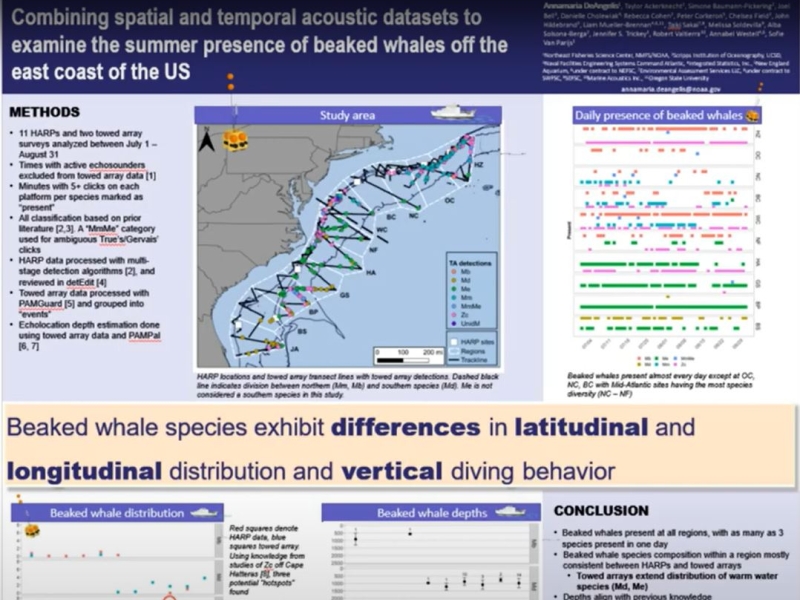
Passive acoustic monitoring was conducted using High-frequency Acoustic Recording Packages (HARPs) deployed in waters offshore of Virginia, North Carolina, and Florida with support from the US Navy during 2016 - 2017. The HARPs recorded underwater sounds between 10 Hz and 100 kHz. Data analysis consisted of analyst scans of long-term spectral averages (LTSAs) and spectrograms, and automated computer algorithm detection when possible. Three frequency bands were analyzed for marine mammal vocalizations and anthropogenic sounds: (1) Lowfrequency, between 10-1000 Hz, (2) Mid-frequency, between 1,000-5,000 Hz, and (3) Highfrequency, between 1-100 kHz.
- 5,208.04 KB
- Blue whale
- Bryde's whale
- Fin whale
- Minke whale
- North Atlantic right whale
- Sei whale
- Atlantic white-sided dolphin
- Blainville's beaked whale
- Bottlenose dolphin
- Clymene dolphin
- Common dolphin
- Goose-beaked whale
- Dwarf sperm whale
- False killer whale
- Gervais' beaked whale
- Killer whale
- Northern bottlenose whale
- Risso's dolphin
- Rough-toothed dolphin
- Short-finned pilot whale
- Sowerby's beaked whale
- Sperm whale
- Spotted dolphin
- Striped dolphin
Killer Whales in the Central Tropical Pacific: Occurrence, Resightings, Morphology, and Acoustics.
Marine Mammal Science. 2026.
Volume 42, Issue 3
More details
Collapse details
Date Published:
- May 11, 2026
More details
Collapse details
Date Published:
Filesize:
- January 1, 2014
A High-frequency Acoustic Recording Package (HARP; Wiggins and Hildebrand 2007) was deployed between August 2011 and July 2012 in Onslow Bay at Site E in 952 m. This HARP sampled at 200 kHz for 5 minutes of every 10 minutes and recorded for 105 days between 19 August 2011 and 1 December 2011. Long-Term Spectral Averages (LTSAs) were created for three frequency bands (10 Hz – 1000 Hz, 500 Hz – 5000 Hz, and 1 kHz – 100 kHz) and scanned for marine mammal vocalizations. Calls of blue whales, fin whales, minke whales, possible sei whales, an unidentified beaked whale species, Blainville’s beaked whales, Cuvier’s beaked whales, Gervais’ beaked whales, killer whales, Kogia spp., Risso’s dolphins, sperm whales, and unidentified delphinids were detected in the data.
- 1,903.07 KB
Echolocation behavior of endangered fish-eating killer whales (Orcinus orca) recorded from digital acoustic recording tags (DTAGs): Insight into subsurface foraging activity.
Journal of the Acoustical Society of America. 2016.
140(4, Part 2):3130
More details
Collapse details
Date Published:
Publication:Species:Methods:
- October 1, 2016
Killer whales are apex predators with diet specializations that vary among ecotypes. Resident killer whales use broadband echolocation clicks to detect and capture fish prey in their underwater environment. Here, we describe the echolocation behavior of endangered Southern Resident killer whales using DTAGs to determine subsurface foraging activity and to assess the effects of vessel and noise on foraging behavior. We deployed 29 DTAGs on individually-identified killer whales and collected complimentary field data over four seasons in summer habitat. DTAGs had two hydrophones that each recorded sound at sampling rates of 192 or 240 kHz, and other sensors to reconstruct whale movement. Prey remains were opportunistically collected during tag deployments to validate feeding. Echolocation signals of the tagged whale were inferred from spectral content and the angle of arrival that corresponded to tag placement. Preliminary results reveal that individuals produced steady click trains during shallow dives then dove to deeper depths while clicking at higher repetition rates that graded into bottom-associated low-level buzzes before ascent occurred. These results, together with movement data, are reliable subsurface foraging cues in this endangered population that can be used to assess vessel effects on foraging behavior.
More details
Collapse details
Date Published:
Filesize:
- April 1, 2024
The U.S. Navy conducts military training and testing in Pacific Northwest range areas to prepare combat-ready military forces, whereas NOAA Fisheries is responsible for managing threatened and endangered species in marine waters and providing permits to the U.S. Navy. NOAA Fisheries and the U.S. Navy share the common goals of minimizing the impact of military training and testing activities on endangered species without compromising training and testing efforts and reducing adverse environmental effects. This work provides vital geographic and distributional data within the Navy’s range areas, allowing the Navy the flexibility to proceed with training and testing while providing protective measures for both salmonids and killer whales. This research jointly studied Chinook salmon and Southern Resident killer whales (SRKW) in the Northwest Training and Testing (NWTT study area) Range. The authors used acoustic telemetry to map salmon behavior and overlap with SRKW occurrence. By tracking Chinook salmon, SRKW's primary prey, the project aims to guide actions to conserve both species. The data will help adjust activities to minimize harm to these protected species. From May to September 2023, 101 Chinook salmon were caught, tagged, and released north of the Columbia River near the Washington Coast. Acoustic transmitters were surgically implanted into the fish, allowing them to be detected by stationary receivers deployed in the ocean, estuaries, and nearby rivers. The fish's locations and movements were recorded and used to Submitted in Support of the U.S. Navy’s 2023 Annual Marine Species Monitoring Report for the Pacific STANDARD FORM 298 Back (Rev. 8/98) assess their spatial distribution and behavior. SRKW detections were also collected from March to October 2023 at 15 passive acoustic moorings on the Washington coast. These acoustic moorings, in combination with the 69 kHz receivers, are currently in operation. All but one of the salmon tagged so far were Snake River spring/summer Chinook ESU and the remaining Chinook origin is yet to be determined. Tasks the are still to be completed include tagging an estimated 60 Chinook salmon and analyzing concurrently collected SRKW data. Spring-run Chinook salmon that are returning to the Columbia River are b
- 3,071.87 KB
More details
Collapse details
Date Published:
Filesize:
- June 1, 2014
This report summarizes information from 24 U.S. Navy-funded aerial surveys of pinniped haulout sites in the inland waters of Washington State conducted between March 2013 and February 2014 by Washington Department of Fish and Wildlife.
- 2,946.44 KB
More details
Collapse details
Date Published:
Filesize:
- August 18, 2013
Passive acoustic monitoring was conducted in the Navy’s Southern California Range Complex during March 2012 through December 2012 to detect the presence of marine mammal and anthropogenic sounds. High-frequency Acoustic Recording Packages (HARPs) recorded sounds between 10 Hz and 100 kHz with continuous temporal coverage at a site near Santa Barbara Island (site M), at a site west of San Clemente Island (site H), and a site southwest of San Clemente Island (site N).
- 21,219.45 KB
More details
Collapse details
Date Published:
Filesize:
- August 1, 2015
A passive-acoustic glider survey was conducted in the Mariana Islands Range Complex between 19 September and 14 November 2014. The goal of the project was to investigate the spatial and temporal distribution of odontocetes and mysticetes in offshore areas adjacent to Guam, Rota, Tinian, and Saipan.
- 7,579.63 KB
More details
Collapse details
Date Published:
Filesize:
- March 1, 2016
A passive-acoustic glider survey was conducted in the Gulf of Alaska Temporary Maritime Activities Area (GoA-TMAA) between 11 July and 21 August 2015 (data collection period: 11 July through 11 August 2015). The goal of the project was to investigate the spatial distribution and temporal occurrence of odontocetes and mysticetes in the northern Gulf of Alaska. The survey focused primarily on the shelf break area between Middleton Island and Kodiak Island. The Gulf of Alaska is generally difficult to survey, and thus the knowledge about the abundance and distribution of cetaceans in this area is limited. Any additional effort improves the understanding and awareness of marine mammal occurrence in the GoA-TMAA.
- 7,691.50 KB
More details
Collapse details
Date Published:
Filesize:
- August 1, 2015
A passive-acoustic glider survey was conducted in the Mariana Islands Range Complex between 19 September and 14 November 2014. The goal of the project was to investigate the spatial and temporal distribution of odontocetes and mysticetes in offshore areas adjacent to Guam, Rota, Tinian, and Saipan.
- 7,252.06 KB
Echolocation click discrimination for three killer whale ecotypes in the Northeastern Pacific.
Journal of the Acoustical Society of America. 2022.
151(5):3197-3206
More details
Collapse details
Date Published:
Publication:Ocean:Species:Methods:
- May 12, 2022
Three killer whale ecotypes are found in the Northeastern Pacific: residents, transients, and offshores. These ecotypes can be discriminated in passive acoustic data based on distinct pulsed call repertoires. Killer whale acoustic encounters for which ecotypes were assigned based on pulsed call matching were used to characterize the ecotype-specific echolocation clicks. Recordings were made using seafloor-mounted sensors at shallow (∼120 m) and deep (∼1400 m) monitoring locations off the coast of Washington state.
Assessing 'Observer effect' from an aerial platform during marine mammal focal observations on Risso's dolphins, short-beaked common dolphins and killer whales in the Southern California Bight.
Southern California Marine Mammal Workshop 2014 .
More details
Collapse details
Date Published:
Filesize:
- January 31, 2014
We systematically video-documented the behavior of a subsample of Risso's dolphins, short-beaked common dolphins (SBCD) and killer whales in the Southern California Bight (SCB) (2009-20 11) to assess whether the observation aircraft (fixed-wing Partenavia) affected selected behavioral variables .
- 8,074.85 KB
‘Observer effect’ from an aerial platform during marine mammal focal observations on Risso’s dolphins, short-beaked common dolphins and killer whales in the Southern California Bight.
20th Biennial Conference on the Biology of Marine Mammals. .
More details
Collapse details
Date Published:
Filesize:
- December 9, 2013
We video-documented the behavior of Risso’s dolphins, shortbeaked common dolphins (SBCD) and killer whales in the Southern California Bight (SCB) (2008-2012) to assess whether the observation aircraft (fixed-wing Partenavia) affected selected behavioral variables. Focal observations were conducted from the aircraft to examine potential changes in group cohesion (minimum and maximum distance between nearest neighbors in body lengths [BL]) and heading reorientation rate, to the plane circling at altitude ~700, 1000, 1500 and 2000 feet (ft). Dependent parameters were selected because previous studies show they are indicative of disturbance to anthropogenic or natural threatening stimuli. Five focal sessions were analyzed: two Risso’s dolphins, two SBCD, and one killer whale. A total of 67 minutes (min) was spent observing Risso’s dolphins, 65 min SBCD and 29 min killer whales. Focal sessions were pooled by species and data were divided into four plane altitude categories: 1750 ft. Analysis of variance (ANOVA) was used to test the null hypothesis that maximum cohesion and reorientation do not vary significantly based on plane altitude. Results suggest that our small plane circling at radial distance 750-1000 ft and altitude 750-2000 ft did not cause measurable changes in cohesion and reorientation, of the three species (based on small sample size). For cohesion (C) and reorientation (R) no significant effects were found (Risso’s dolphin: p = 0.091 and 0.258; SBC: p = 0.068 and 0.847; killer whale: p = 0.270 and 0.060 [C and R, respectively]). Results suggest that “undisturbed” baseline observations can be made on these species from our aircraft within parameters examined. This is important when using the aircraft to assess baseline marine mammal behavior and potential effects of anthropogenic activities relative to management and conservation needs.
- 8,074.85 KB
More details
Collapse details
Date Published:
Filesize:
- March 1, 2022
This report documents Naval Information Warfare Center (NIWC) Pacific marine mammal monitoring efforts in fiscal year (FY) 2021 for Commander, Pacific Fleet (COMPACFLT) at the Pacific Missile Range Facility (PMRF), Kaua‘i, Hawai‘i.
- 8,971.43 KB
More details
Collapse details
Date Published:
Filesize:
- April 1, 2023
This report documents Naval Information Warfare Center Pacific (NIWC Pacific) marine mammal monitoring efforts in fiscal year (FY) 2022 for Commander, Pacific Fleet (COMPACFLT) at the Pacific Missile Range Facility (PMRF), Kaua'i, Hawai
- 6,631.24 KB
More details
Collapse details
Date Published:
Filesize:
- September 1, 2021
This report documents Naval Information Warfare Center Pacific (NIWC Pacific) marine mammal monitoring efforts in fiscal year (FY) 2020 for Commander, Pacific Fleet (COMPACFLT) at the Pacific Missile Range Facility (PMRF), Kauai, Hawaii.
- 5,007.00 KB
More details
Collapse details
Date Published:
Filesize:
- March 20, 2020
This report documents Naval Information Warfare Center Pacific (NIWC Pacific) marine mammal monitoring efforts in fiscal year (FY) 2019 for Commander, Pacific Fleet (COMPACFLT) at the Pacific Missile Range Facility (PMRF), Kauai, Hawaii.
- 8,708.37 KB
More details
Collapse details
Date Published:
Filesize:
- May 3, 2019
This report documents Space and Naval Warfare Systems Center Pacific marine mammal monitoring efforts in FY18 for COMPACFLT at PMRF in Kauai, Hawaii.
- 2,687.96 KB
More details
Collapse details
Date Published:
Filesize:
- July 31, 2018
This report documents Space and Naval Warfare Systems Center Pacific (SSC Pacific) marine mammal monitoring efforts in FY17 for Commander, Pacific Fleet (COMPACFLT) at the Pacific Missile Range Facility (PMRF), Kauai, Hawaii.
- 4,775.66 KB
More details
Collapse details
Date Published:
Filesize:
- July 1, 2025
This report documents the Naval Information Warfare Center (NIWC) Pacific Whale Acoustic Reconnaissance Project (WARP) Laboratory’s marine mammal monitoring efforts in fiscal year (FY) 2024 for Commander, Pacific Fleet (COMPACFLT) at the Pacific Missile Range Facility (PMRF), Kaua‘i, Hawai‘i.
- 6,328.43 KB
More details
Collapse details
Date Published:
Filesize:
- September 9, 2024
This report documents the Naval Information Warfare Center (NIWC) Pacific Whale Acoustic Reconnaissance Project (WARP) Laboratory’s marine mammal monitoring efforts in fiscal year (FY) 2023 for Commander, Pacific Fleet (COMPACFLT) at the Pacific Missile Range Facility (PMRF), Kaua‘i, Hawai‘i.
- 10,102.05 KB
Got Milk? Aircraft Observations Provide Rare Glimpses into Whale Calf Nursing and Back Riding.
Southern California Marine Mammal Workshop 2012. .
More details
Collapse details
Date Published:
Filesize:
- February 3, 2012
Nursing behavior by large cetaceans in situ is not well described. During -30,000 km of aerial surveys off Southern California to monitor marine mammals relative to U.S. Navy military training activities (2008-2011 ), nursing behaviors were documented for three species: Eastern Pacific gray whale (Eschrichtius robustus), fin whale (Ba/aenoptera physa/us) and killer whale (Orcinus orca). Photographs, video, notes and audio recordings were used to analyze mother-calf interactions. Back riding occurred in gray and fin whales, as described for bowhead whale (Ba/aena mysticetus) mother-calf pairs by Wursig et al. (1999). During slow sub-surface travel, a fin whale calf swam alongside mother's peduncle area, touching her head-first for short (
- 1,020.09 KB
More details
Collapse details
Date Published:
Filesize:
- January 1, 2012
During FY2012, with funding provided by the Chief of Naval Operations (CNO) N45 Energy and Environmental Readiness Division, the Marine Mammal Monitoring on Navy Ranges (M3R) program carried out several acoustic monitoring efforts to determine the spatial and temporal distribution of cetacean species on the Southern California Anti-Submarine Warfare (ASW) Range (SOAR) , to document the reaction of these species to sonar with a focus on beaked whales, and to provide a means of longterm passive acoustic monitoring. Specifically, M3R participated in a number of marine mammal species visual verification and tagging tests, ONR-sponsored glider tests, the SOCAL 2011-12 Behavioral Response Study (BRS), and for the first time conducted low-frequency acoustic monitoring of baleen whales.
- 2,344.53 KB
More details
Collapse details
Date Published:
Filesize:
- July 1, 2015
With funding from the Living Marine Resources (LMR) Program, the Marine Mammal Monitoring on Navy Ranges (M3R) passive acoustic monitoring system has been installed at the Pacific Missile Range Facility (PMRF). The overall goal of the program is to provide tools and methodologies for long-term monitoring of marine mammal populations. The program is laying the groundwork needed to adapt combined passive acoustic, tagging, and visual monitoring methods for animals and conditions at PMRF. For sonar-sensitive Blainville’s beaked whales (Mesoplodon densirostris; Md), the short- and long-term distribution, density, and habitat can be measured provided basic behavioral data such as group size and dive rates at PMRF are known.
- 2,873.86 KB
More details
Collapse details
Date Published:
Filesize:
- March 22, 2022
The United States (US) Navy uses lookouts (LOs) to detect objects in the water in the vicinity of ships. One class of object that LOs are trained to detect is marine mammals ; this forms an important component of the Navy’s procedures for marine mammal mitigation during training activities . As well as dedications of marine mammals by these LOs, detections of marine mammals may also be made by other members of the ship’s crew such as officers on the bridge (“watchstanders”) or sonar technicians, although acoustic detections require visual confirmation. We refer to these personnel together as the “lookout team” (LT). The primary goal of this project was to determine how effective LTs are at detecting marin
- 4,078.84 KB
- California sea lion
- Green turtle
- Leatherback turtle
- Loggerhead turtle
- Kemp's Ridley turtle
- Blue whale
- Fin whale
- Humpback whale
- Minke whale
- Atlantic white-sided dolphin
- Common dolphin
- Harbor porpoise
- Killer whale
- Pantropical spotted dolphin
- Pilot whale
- Risso's dolphin
- Rough-toothed dolphin
- Short-finned pilot whale
- Sperm whale
- Spotted dolphin
- Striped dolphin
More details
Collapse details
Date Published:
Filesize:
- February 1, 2020
Passive acoustic monitoring was conducted in the Gulf of Alaska Temporary Maritime Activities Area (GATMAA) from September 2017 to June 2018 and from April to September 2019 to record the low-frequency ambient soundscape and detect marine mammal and anthropogenic sounds during times of naval exercises in the area. High-frequency Acoustic Recording Packages (HARPs) recorded sounds between 10 Hz and 100 kHz at two locations: a continental slope site in deep water (~900–1,000 m depth, site CB) and a deep-water site off Kodiak Island (~1,000 m depth, site KOA). The low-frequency ambient soundscape showed spectrum level peaks at both sites during winter and fall, related to the seasonally increased presence of blue and fin whales.
- 20,111.75 KB
More details
Collapse details
Date Published:
Filesize:
- December 1, 2019
Passive acoustic monitoring was conducted in the Gulf of Alaska Temporary Maritime Activities Area (GATMAA) from September 2017 to September 2019 to record the low-frequency ambient soundscape and detect marine mammal and anthropogenic sounds during times of naval exercises in the area. High-frequency Acoustic Recording Packages (HARPs) recorded sounds between 10 Hz and 100 kHz at two locations: a continental slope site in deep water (~900–1,000 m depth, site CB) and a continental shelf site off Kodiak Island (~1,000 m depth, site KOA).
- 850.16 KB
More details
Collapse details
Date Published:
Filesize:
- June 1, 2015
For this report, killer whale signals were analyzed for periods of deployment from January 2011 – April 2014 in order to determine the seasonal occurrence and distribution of different killer whale ecotypes at these sites.
- 348.81 KB
More details
Collapse details
Date Published:
Filesize:
- January 1, 2023
Three different killer whale (Orcinus orca) ecotypes are known to inhabit the northeastern Pacific: residents, transients, and offshores. These ecotypes are distinguished by morphological, genetic, behavioral, and acoustic differences. Killer whales of each ecotype produce distinct, stereotypic pulsed calls that can be used as acoustic indicators of presence, making passive acoustic monitoring a useful method for assessing intraspecies differences in spatial and temporal patterns.
- 1,251.17 KB
Cetacean occurrence in the Gulf of Alaska from long term passive acoustic monitoring.
Marine Biology. 2021.
68(72):1-29
More details
Collapse details
Date Published:
Publication:Ocean:Region:Species:Methods:
- April 24, 2021
The Gulf of Alaska is an important habitat for a diverse array of marine mammals, many of which were severely depleted by historical whaling. To study current cetacean distributions in this region, passive acoustic monitoring was used to detect species-specific call types between 2011 and 2015 at five locations spanning the continental shelf, slope, and offshore seamounts. Spatial and temporal detection patterns were examined for nine species to compare differences in behavior and habitat use.
More details
Collapse details
Date Published:
Filesize:
- December 23, 2016
To effectively protect and manage marine mammals, contemporary information on their abundance and distribution is essential. Several factors influence presentday insight including the accessibility of the study area and the degree of difficulty in locating and studying target species.
- 1,631.76 KB
More details
Collapse details
Date Published:
Filesize:
- April 1, 2014
During this survey, the visual team surveyed 4,504 kilometers (km) of ‘full-effort,’ which included 349 km of ‘transit-effort.’ There was an additional 375 km of ‘fog-effort’ (transect and transit). Based on total effort, there were 802 sightings (1,998 individuals) of 13 confirmed marine mammal species, with an additional 162 sightings (228 individuals) of unidentified cetaceans and pinnipeds (including those recorded on transit and during off-effort mode).
- 12,416.19 KB
More details
Collapse details
Date Published:
Filesize:
- April 1, 2009
During this project, the visual survey covered a total of 760 kilometers (410 nautical miles) on-effort while transit and fog effort legs accounted for 553 km (298 nm). There were a total of 96 sightings (453 individuals) of 11 confirmed marine mammal species; these included fin, humpback, gray, and minke whales as well as killer whales, Dall’s and harbor porpoise, Pacific white-sided dolphins and Steller sea lions, harbor seals and sea otters. Additionally, there were 36 sightings (46 individuals) of unidentified large whales, dolphins and pinnipeds. Acoustically, operations were conducted 24-hours/day surveying a total of 3,519 km (1,900 nm) and recording 49 acoustic detections of sperm whales and killer whales. Photographs of nineteen individual killer whales and four fin whales were obtained on this cruise and compared to existing catalogs.
- 1,894.30 KB
More details
Collapse details
Date Published:
Publication:Ocean:Region:Species:Methods:
- January 1, 2017
To effectively protect and manage marine mammals, contemporary information on their abundance and distribution is essential. Several factors influence present-day insight including the accessibility of the study area and the degree of difficulty in locating and studying target species. The offshore waters of the Gulf of Alaska are important habitat to a variety of cetaceans yet have remained largely unsurveyed due to its remote location, vast geographic area, and challenging environmental conditions. Between 2009 and 2015, three vessel surveys were conducted using line-transect sampling methods to estimate cetacean abundance and density. Here, we present results on the distribution for all species encountered and density and abundance for six species, including humpback whales (Megaptera novaeangliae), fin whales (Balaenoptera physalus), sperm whales (Physeter macrocephalus), blue whales (B. musculus), killer whales (Orcinus orca), and Dall’s porpoise (Phocoenoides dalli). Fin whales, humpback whales, and Dall’s porpoise were the most abundant species. Beaked whales were documented only in 2015. Prior to this study, recent sightings of blue whales were rare, likely related to the lack of offshore survey coverage. No North Pacific right whales (Eubalaena japonica) were sighted, underscoring the critically endangered status of this species in a formerly populous habitat. Although these results provide the first estimates from offshore waters, additional effort is necessary to assess trends and to obtain baseline data for the rare and cryptic species in order to better inform conservation and management actions.
More details
Collapse details
Date Published:
Filesize:
- June 1, 2013
This report summarizes the results of deployments within the Northwest Training Range Complex (NWTRC) conducted in conjunction with existing survey efforts off Washington and also includes results from additional deployments on the same species funded with other sources and which are best reported together.
- 2,533.59 KB
More details
Collapse details
Date Published:
Filesize:
- December 31, 2022
The Southern California (SOCAL) portion of the Hawaii-Southern California Training and Testing (HSTT) area (SOCAL TR) is one of the United States Navy’s most active training areas, particularly for mid-frequency active sonar (MFAS). Much of SOCAL lies within the Southern California Bight, a productive oceanographic region that hosts a wide variety of marine species. As part of an ongoing study of the distribution and demographics of several marine mammal species within SOCAL, we conducted 32 days of survey effort from 6 January 2022 to 26 November 2022, specifically focusing on the Southern California Anti-submarine Warfare Range (SOAR).
- 2,783.94 KB
Movements and Diving Behavior of the Eastern North Pacific Offshore Killer Whale (Orcinus orca).
Frontiers in Marine Science. 2022.
9:854893
More details
Collapse details
Date Published:
Publication:Ocean:Region:Species:Methods:
- May 24, 2022
The Pacific Offshore killer whale population is currently listed as data deficient on the IUCN Red List and Threatened in Canada. The population is estimated at 300 individuals with a range extending from Southern California to the Aleutian Islands in Alaska. Only 157 encounters with this ecotype have been photo-documented between 1988 and 2014; consequently, movement and behavioral data are limited and restricted to areas commonly surveyed. To better understand movements, habitat use, and diving behavior, we deployed seven dart-attached satellite tags during two encounters with Offshores off California and one encounter off Washington State in 2013.
More details
Collapse details
Date Published:
Filesize:
- June 1, 2023
This study aims to improve the understanding of the extent to which bull trout (Salvelinus confluentus), a threatened species, exhibit anadromous behavior or migrate between freshwater and saltwater environments, between coastal rivers on the Olympic Peninsula in Washington state and adjacent to the Navy’s Northwest Training and Testing (NWTT) Study Area
- 1,620.93 KB
More details
Collapse details
Date Published:
Filesize:
- October 1, 2010
In support of the U.S. Navy’s (Navy) Marine Mammal Monitoring Plan (M3P) in the Southern California Range Complex (SOCAL) (DoN 2009), aerial surveys were conducted by Smultea Environmental Sciences (SES) to monitor marine mammals and sea turtles (MM/ST) during November 2009 in the SOCAL area. This was the fifth such aerial survey in SOCAL conducted by SES or SES/Marine Mammal Research Consultants (MMRC).
- 9,778.80 KB
More details
Collapse details
Date Published:
Filesize:
- December 31, 2015
From 2013 to 2015, researchers conducted systematic line-transect aerial surveys for marine mammals in eight subregions of Puget Sound encompassing inland waters of Washington State. Effort consisted of five separate survey periods spanning four seasons (winter, spring, summer and fall) and was funded by the United States Navy (Navy). Surveys focused on estimating seasonal in-water density and abundance of cetaceans, particularly harbor porpoise (Phocoena phocoena).
- 5,860.87 KB
More details
Collapse details
Date Published:
Filesize:
- June 1, 2017
From 2013 to 2016, we conducted systematic line-transect aerial surveys in 8 sub-regions of Puget Sound encompassing inland waters of Washington State. U.S.-funded surveys were conducted year-round and focused on estimating seasonal in-water density and abundance of marine mammals, particularly harbor porpoises and harbor seals
- 4,652.56 KB
Assessing ‘observer effects’ from a research aircraft on behavior of three Delphinidae species (Grampus griseus, Delphinus delphis, and Orcinus orca).
2016.
12(2):75-90
More details
Collapse details
Date Published:
Ocean:Region:Species:Methods:
- January 1, 2016
Three species of Delphinidae: Risso’s dolphin (Grampus griseus), common dolphin (Delphinus delphis), and killer whale (Orcinus orca) were systematically video-documented during aerial surveys in the Southern California Bight (2009-2011) to assess whether the observation aircraft (fixed-wing Partenavia) affected selected behavioral variables. Focal observations were conducted to examine potential changes in group cohesion and heading reorientation rate to the plane circling at four altitudes: 213 m, 305 m, 457 m, and 610 m, whilst maintaining a lateral distance >500 m. Paired t-tests were used to test the null hypothesis that mean maximum cohesion and mean reorientation of groups do not vary significantly based on plane altitude. For cohesion, no significant effects were found for the eight G. griseus focal sessions (p = 0.447), one D. delphis session (p = 0.602) and one O. orca session (p = 0.197). For reorientation, no significant effects were found for the eight G. griseus focal sessions (p = 0.591) and one O. orca session (p = 0.936); the sample size was too small to calculate reorientation for D. delphis. Results suggest that our small plane circling at lateral distance >500 m and altitude 213 – 610 m did not cause measurable changes in cohesion and reorientation, or other observable changes for the three species. This may be due to the aircraft remaining >500 m lateral distance from the animals and at altitudes well outside (>2.5-9.2 times) the theoretical lateral distance of the 13̊ radial sound transmission cone (“Snell’s cone”) below the aircraft (via which sound can pass through the air-water interface under calm sea conditions), thus avoiding adverse levels of sound intercepting the delphinids.
Changes in Relative Occurrence of Cetaceans in the Southern California Bight: A Comparison of Recent Aerial Survey Results with Historical Data Sources.
Aquatic Mammals. 2014.
40(1):32-43
More details
Collapse details
Date Published:
Publication:Ocean:Region:Species:Methods:
- August 6, 2014
The relative occurrence of the 16 most common cetacean species in the Southern California Bight (SCB) was compared from the 1950s through 2012 by examining at-sea sighting and stranding data. While systematic survey and population abundance/density data have been available since the 1970s, prior data were collected opportunistically. Comparisons were made through a literature review and using recent results from 15 aerial surveys conducted in the SCB from 2008 through 2012. We attempted to address inconsistency in type of effort across studies by ranking the relative sighting frequency of the most common species based on the most representative study for each period. This comparison revealed changes in the relative occurrence of some species across the approximately 60-y reviewed period. Since the 1950s, common dolphins have remained the most common “species” of cetacean in the SCB. Risso’s dolphin and fin, blue, humpback, and Bryde’s whales appear to have increased in relative occurrence. The relative occurrence of the common bottlenose and northern right whale dolphins; Dall’s porpoise; and gray, killer, minke, Cuvier’s beaked, and sperm whales do not appear to have changed notably since the 1950s. There is possible indication of recent decreased relative occurrence of the Pacific white-sided dolphin. The short-finned pilot whale has decreased since the 1950s and has not been recorded in the SCB since the 1990s, concurrent with the observed relative increase in Risso’s dolphins. Overall, recent aerial surveys indicate that the 16 most commonly seen species in the SCB, in descending order of frequency, were common dolphins (two species), Risso’s dolphin, fin whale, common bottlenose dolphin, gray whale, blue whale, Pacific white-sided dolphin, humpback whale, northern right whale dolphin, common minke whale, Dall’s porpoise, killer whale, Bryde’s whale, Cuvier’s beaked whale (the latter three tied in ranking), and sperm whale. Given that the reviewed historical data from the 1950s and 1960s are virtually the only sources of information available to examine trends over the last 50 to 60 y in this area, we believe this comparative ranking approach provides useful information not available from other sources.
Behaviors of Southern California cetaceans: observations from a small aircraft 2008-2013.
107th Annual Meeting of the Southern California Academy of Sciences .
More details
Collapse details
Date Published:
Filesize:
- May 2, 2014
Small aircraft enable a “bird’s eye” view of marine mammal behavior at/near the water surface. During 2008-2013, we flew 87,734 km of line transect and “focal follow” aerial survey effort in the Southern California Bight to systematically collect data on 2,707 sightings of ~222,457 individual cetaceans representing 19 species, funded by the U.S. Navy Pacific Fleet. Focal follows involved circling a cetacean group for 5-60+ minutes and taking high-definition (HD) video and photos to document behavior primarily of blue, fin, gray, humpback, sperm, minke and killer whales; and Risso’s, common bottlenose, short-beaked and long-beaked common, and northern right whale dolphins. HD media allow photoidentification of individuals and species confirmation from altitudes of 1,000-1,500 feet. The “bird’s eye” 71 perspective facilitates descriptive and quantitative analyses of behavior previously little described for typically offshore species: whale calf nursing/back-riding, group cohesion, social affinity/composition, group shape and dimension “envelope”, cues leading to group behavior changes, mixed species interactions, individual whale respiration/dive rates, etc. Behavior differs significantly by species, calf presence, time of day, time of year, subregion, water depth, slope, distance from shore, and presence of other species. For example, Risso’s dolphins were 13 times more likely to rest than common dolphins, and dolphin group size increased significantly with calf presence. As species body size decreases, group size increases and individuals decrease distance between neighbors. We hypothesize that inter-specific differences of spacing and behavior are related to predation pressure, food resources, and communication capabilities/needs that lead to occupation of different niches within the same ecosystem.
- 6,829.46 KB
Cetacean mother-calf behavior observed from a small aircraft off Southern California.
Animal Behavior and Cognition. 2017.
4: 1-23
More details
Collapse details
Date Published:
Publication:Ocean:Region:Species:Methods:
- February 1, 2017
During early developmental stages, cetacean calves are dependent on their mothers for survival. Protection of young whales engaged in behaviors that are biologically important is critical for population recovery, so that appropriate management actions can be taken to minimize human disturbance. However, the occurrence and frequency of whale nursing and calves back-riding their mothers (both considered important to calf survival) have rarely been observed nor adequately quantified or defined. Therefore, it may not always be clear when disruption is occurring. We used extended behavioral observations, still photography, and video camera footage obtained during aircraft surveys in the Southern California Bight in 2008 – 2013 to characterize cetacean mother-calf interactions. Based on observations of four mother/calf pairs (two gray whale, Eschrichtius robustus, one fin whale, Balaenoptera physalus, and one blue whale, B. musculus) and one killer whale presumed mother/yearling pair (Orcinus orca), we describe bouts of nursing and calves riding on the backs of their presumed mothers, including activity duration, frequency, and relative body positioning. We conclude with specific definitions useful to wildlife conservation agencies authorizing and establishing restrictions to certain human activities when they might constitute behavioral disruptions.
More details
Collapse details
Date Published:
Filesize:
- September 26, 2014
The purpose of this report is to compile previously unpublished sightings of marine mammals and sea turtles made in the Mariana Islands Range Complex. The original primary goal of this report was to compile such sightings incidentally made during Navy-funded field efforts or other Navy training. However during the course of compiling these data, additional incidental sightings made by other sources were encountered.
- 1,354.66 KB
More details
Collapse details
Date Published:
Filesize:
- August 31, 2011
The goal of this initial phase is to process and compile available data from visual surveys performed by both contractor‐led efforts as well as Navy in‐house ones, such that: 1. A GIS‐based summation of all survey tracks could be visualized 2. A geo‐referenced database of sightings can be queried to visualize sightings by species or survey variables such as observer platform, sea state, or season
- 2,020.33 KB
More details
Collapse details
Date Published:
Filesize:
- January 1, 2020
Long-term high-frequency acoustic recording packages (HARPs) at eight sites along the western North Atlantic shelf break.
- 1,430.35 KB
- Blue whale
- Fin whale
- Humpback whale
- North Atlantic right whale
- Sei whale
- Atlantic white-sided dolphin
- Blainville's beaked whale
- Bottlenose dolphin
- Common dolphin
- Goose-beaked whale
- False killer whale
- Gervais' beaked whale
- Killer whale
- Northern bottlenose whale
- Pilot whale
- Rough-toothed dolphin
- Short-finned pilot whale
- Sowerby's beaked whale
- Sperm whale
- Spotted dolphin
- Striped dolphin
- True's beaked whale
More details
Collapse details
Date Published:
Filesize:
- November 11, 2024
This review examines historical data from 535 odontocete stranding events in the Mariana archipelago and Hawaiian Islands by date, location and species and spans the time period of 1848 to 2023. Reports of strandings increased across the two geographic regions that were generally consistent over time. A total of 54 historical stranding events that represent 14 odontocete species are described for the Mariana Islands. A total of 481 stranding events that represent 19 odontocete species are described from the Hawaiian Islands, significantly updating the last published report that examined 202 odontocete strandings that occurred in the main Hawaiian Islands between 1937 and 2002. ArcGIS cluster maps were utilized to identify groupings of stranding events across the geographic regions. The majority of strandings in the Mariana Islands were reported from the west and southeastern coast of Guam, followed by Saipan, Rota and Tinian. Stranding hotspots in the Hawaiian Islands were identified at Mā’alaea Bay, Maui, at windward Oʻahu and near Kailua-Kona on Hawaiʻi Island.
- 493.28 KB
More details
Collapse details
Date Published:
Filesize:
- September 16, 2024
The University of Hawaii Health and Stranding Lab located at Marine Corps Base Hawaii (MCBH) is the only entity in the Pacific Islands region that responds to strandings, conducts necropsy and cause of death investigations, archives tissues and performs research to identify and evaluate threats to Pacific Island cetaceans. This project focuses on increasing our understanding of infectious diseases in the Pacific Island region by investigating the emerging diseases caused by circovirus, morbillivirus, herpesvirus and toxoplasmosis infections in cetaceans.
- 514.82 KB
More details
Collapse details
Date Published:
Filesize:
- September 9, 2024
We report significant pathological findings from 250 stranding investigations of 20 cetacean species in the Pacific Islands region between 2006 and 2022. Full or partial necropsies of 196 of the 250 stranding cases (78.4%) resulted in a diagnosis or multiple diagnoses associated with death in 126 cases. Natural disease accounted for 60.3% of stranded animals; approximately half were in poor body condition at time of death due to chronic illness. Morbillivirus and Brucella sp. infections caused mortality in eleven species, including striped dolphins and the Longman’s beaked whale. Toxoplasma infection, of anthropogenic cause in Hawaiʻi, led to the deaths of two spinner dolphins. Pygmy and dwarf sperm whales, beaked whales and pilot whales showed heavy parasitism by nematodes, cestodes and trematodes. Approximately 12.7% of stranded individuals were perinates/neonates, with three cases of dystocia with maternal mortality. Anthropogenic trauma was observed in 30.2% of strandings. In seven Cuvier’s beaked whales, cranial and/or microvascular hemorrhages were categorized as trauma. Vertebral and skull fractures were attributed to direct vessel strikes for two pygmy sperm whales, a Cuvier’s beaked whale, a humpback whale calf and a striped dolphin. Blast trauma was observed in three Fraser’s dolphins that were part of an uncommon stranding event. Significant plastic debris, and/or fishery debris were found in stomachs of six species and fatal fishhook penetration occurred in a Submitted in Support of the U.S. Navy’s 2023 Annual Marine Species Monitoring Report for the Pacific STANDARD FORM 298 Back (Rev. 8/98) bottlenose dolphin. This study highlights the value of carcass examinations in a region inhabited by small island associated populations where carcass recovery rates are low, and cetaceans face an array of natural and anthropogenic threats.
- 1,496.52 KB
- Humpback whale
- Blainville's beaked whale
- Bottlenose dolphin
- Goose-beaked whale
- Dwarf sperm whale
- False killer whale
- Fraser's dolphin
- Killer whale
- Longman’s beaked whale
- Melon-headed whale
- Pilot whale
- Pygmy killer whale
- Risso's dolphin
- Rough-toothed dolphin
- Short-finned pilot whale
- Sperm whale
- Spinner dolphin
- Spotted dolphin
- Striped dolphin
More details
Collapse details
Date Published:
Filesize:
- August 6, 2025
The Alaska Fisheries Science Center (AFSC), NOAA Fisheries, with support from the U.S. Navy, conducted line transect surveys in Behm Canal and adjacent areas in the spring of 2023 and fall of 2024 to obtain estimates of density and abundance of cetaceans and information on marine mammal distribution and occurrence.
- 9,210.00 KB
Current
Acoustic Ecology of Northwest Atlantic Shelf Break Cetaceans and Effects of Anthropogenic Noise Impacts
Project Objectives
Assess the acoustic niche of marine mammal species and anthropogenic contributors to disturbance
Current
Mid-Atlantic Offshore Cetacean Study
Project Objectives
Assess occurrence, habitat use, and baseline behavior of cetaceans in the offshore and continental shelf break region of the VACAPES OPAREANo related blog posts to display